






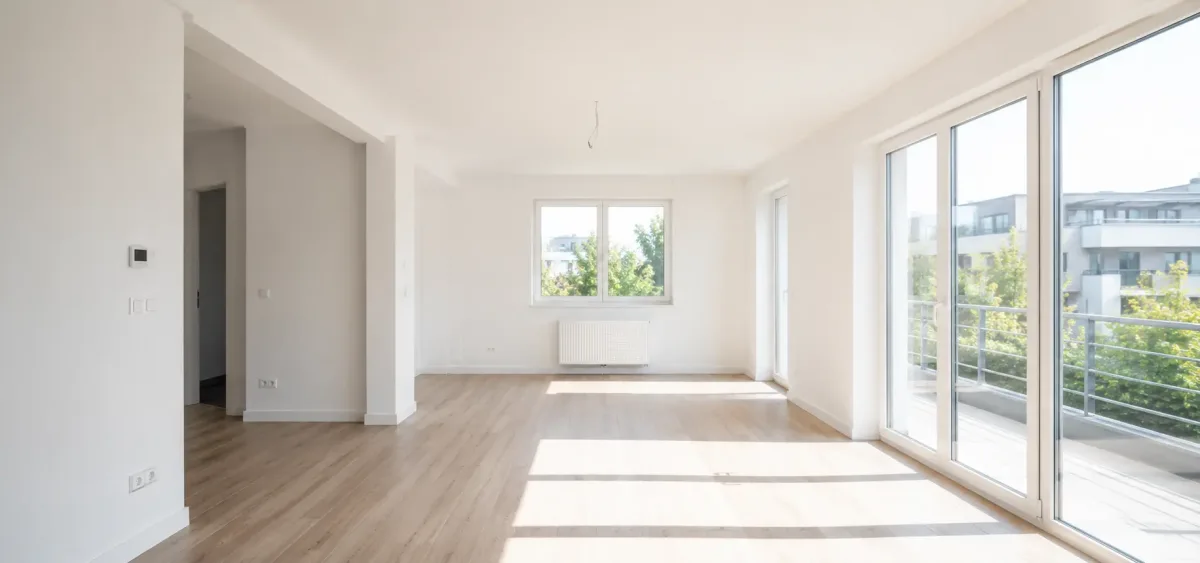
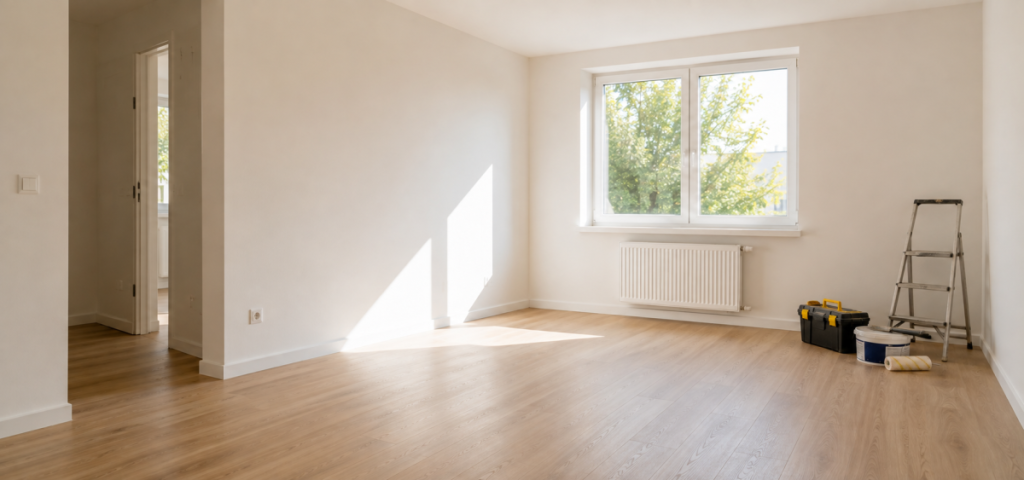
The works are finished. The masters are gone. And there remained a space that looks like no one will be able to live in it for another month.
Construction dust is a special kind of problem. It doesn't shrink like a regular one — it does precipitates in layers, gets into every crack, clings to the glass and stays in the air for days after the work is done.
This text explains why standard cleaning does not help, what stages the space must go through after the work, how long it takes and how much it costs.
Why ordinary cleaning is not enough
People usually try it on their own first. So they buy more cloths. So they try again. The reason why it doesn't work is physical.
The dust is mineral, not organic
House dust is mainly cloth, hair and skin. It is construction cement, gypsum, lime and stone dust — particles that are hard, sharp and much finer.
It does not collect, but spreads
When you wipe away plaster dust with a damp cloth, it turns into a thin layer that dries and remains. That's why it looks like the space is blurry no matter how much you wipe it.
An ordinary vacuum cleaner cannot withstand it
Small mineral particles pass through a standard filter and are returned to the air. In addition, they destroy the engine — many vacuum cleaners grind to a halt just after one such cleaning.
It goes back days.
Particles remain in the air and settle gradually. That's why the area you cleaned yesterday has a layer of dust again tomorrow. Without proper sequence, it repeats itself in a circle.
Residues cannot be removed with water.
Silicone, glue, plaster, paint, leftover grout and protective film require resources and tools — not effort.

Cleaning phases after work
The order is not arbitrary. If it is skipped or reversed, the work must be repeated.
Phase 1 — Removal of bulky waste
First, everything that can be picked up by hand comes out: leftover materials, cardboard boxes, pieces of plaster, foils, packaging.
If there is a lot of waste, arrange for collection separately — it is often charged separately from cleaning.
Stage 2 — Dry vacuuming from top to bottom
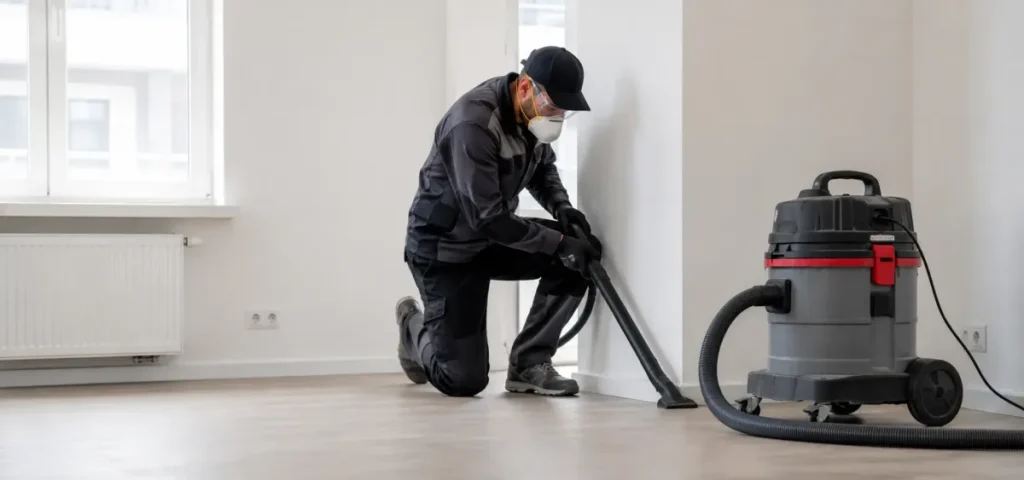
An industrial vacuum cleaner with a HEPA filter, and that strictly top down: ceiling, walls, radiators, windowsills, and only then the floor.
The reverse order means that everything you remove from the wall falls on the already cleaned floor.
Stage 3 — Removal of residues and stains
Silicone, glue, paint, plaster, remains of grout, stickers from carpentry and protective film. This is manual work that takes the most time and requires the right tools for each type of surface.
Stage 4 — Wet cleaning of all surfaces
Walls where the color allows, joinery, doors, door frames, switches, sockets, interior of cupboards and shelves.
Phase 5 — Windows and glass surfaces
Glass, frames, grooves and exteriors. The windows are left for last because they get dirty from each previous stage.
For larger facilities, this is often done by a separate team — see washing windows and glass surfaces.
Phase 6 — Floors
Multiple passes, not one. In the case of tiles and stone, machine washing is usually followed to remove the milky layer that remains from cement dust.
More details about this in the service description machine cleaning and floor washing.
Phase 7 — Final Pass
A day or two later, when what's left in the air settles. Most people skip this stage — and that's why the space is "dusty again".
How long does it take?
It depends on the square footage and scope of work. Roughly, for a team of two to three people:
| Facility | Duration |
|---|---|
| Apartment up to 50 m² | 4–6 hours |
| Apartment 50–100 m² | 1 day |
| Apartment over 100 m² | 1–2 days |
| House up to 200 m² | 2 days |
| House over 200 m² | 2–3 days |
| Business premises | depends on the purpose, usually 1-3 days |
What prolongs time: lots of woodwork and glass surfaces, space that was in use during the works, stone or tiles with a rough texture, and cases where contractors left more waste than agreed.
How much does cleaning after work cost?
The price is most often formed per square, because the scope of work varies too much for a lump sum to be fair to both parties.
| Object type | Approximate per m² |
|---|---|
| Apartment after renovation | €3–6 |
| New construction, first time | €4–8 |
| House | €4–7 |
| Business premises | €3–7 |
What does this mean in practice?
Apartment of 70 m² after adaptation: approx €210–420.
150 m² house: approximately €600–1,050.
What is not usually included in the basic price
- Construction waste removal
- Machine polishing of floors
- Washing facade glasses from the outside above the ground floor
- Cleaning of ventilation ducts
Are you looking for an offer that explicitly states what is and is not included. This is the service where it most often happens that the final figure is higher than agreed — almost always because of items that no one mentioned at the beginning.
For a comparison with other types of cleaning, see How much does it cost to clean an apartment and a house in Montenegro.
When a maid can do it, and when an agency is needed
Not every case is the same.
A cleaning lady is sufficient when:
- The work was small — one room was painted, the door was replaced
- There is no mineral dust in large quantities
- The space is small and the furniture was protected
- You've already done the rough cleaning, you just need the final pass
An agency is needed when:
- Walls were demolished, plaster was sanded or tiles were cut
- It is a new building that is being cleaned for the first time
- The space is larger than a hundred square meters
- The floors need to be machine washed.
- There is a lot of woodwork and glass surfaces
- Waste collection is also needed.
- The deadline is short — moving in or handing over is in a few days
If you're not sure which side you fall on, see the broader comparison in the text Housekeeper or cleaning agency.

What to do before the team arrives
A few little things that shorten the work and lower the price.
Arrange with the contractor to take away your waste. This is their duty, but it is often "forgotten". Solve it before they leave.
Check that the work is actually completed. If something still needs to be improved or repainted, wait. Cleaning before the end of the work is a waste of money.
Provide water and electricity. It is impossible to work without it, and it can happen that in new buildings they are not connected yet.
Tell me what is sensitive. New parquet, stone slabs, painted walls in matte technique — each of these surfaces requires a different approach.
Ask for a quote in writing. With a list of stages and a clear indication of what is not included.
How to find an agency
On Spremačica.me, agencies are classified by services and cities.
- Open Cleaning after construction works and browse agencies that do exactly that type of work
- Narrow the selection to your city through agency listing
- You are looking for an offer from two to three agencies, with a clear list
- The contact is direct — without intermediaries and without commission
Do you run an agency? Register your agency for free or read more on the page For agencies.
Conclusion
Cleaning after construction work is the last phase of construction, not the first phase of moving in. A space that is entered only when the mineral dust is actually removed — not smeared.
If the work was serious, this is not a mop and bucket job. Get an offer that lists the stages, ask for a final walk-through in a day or two, and move into a space that's actually finished.
👉 Review cleaning agencies after work

